
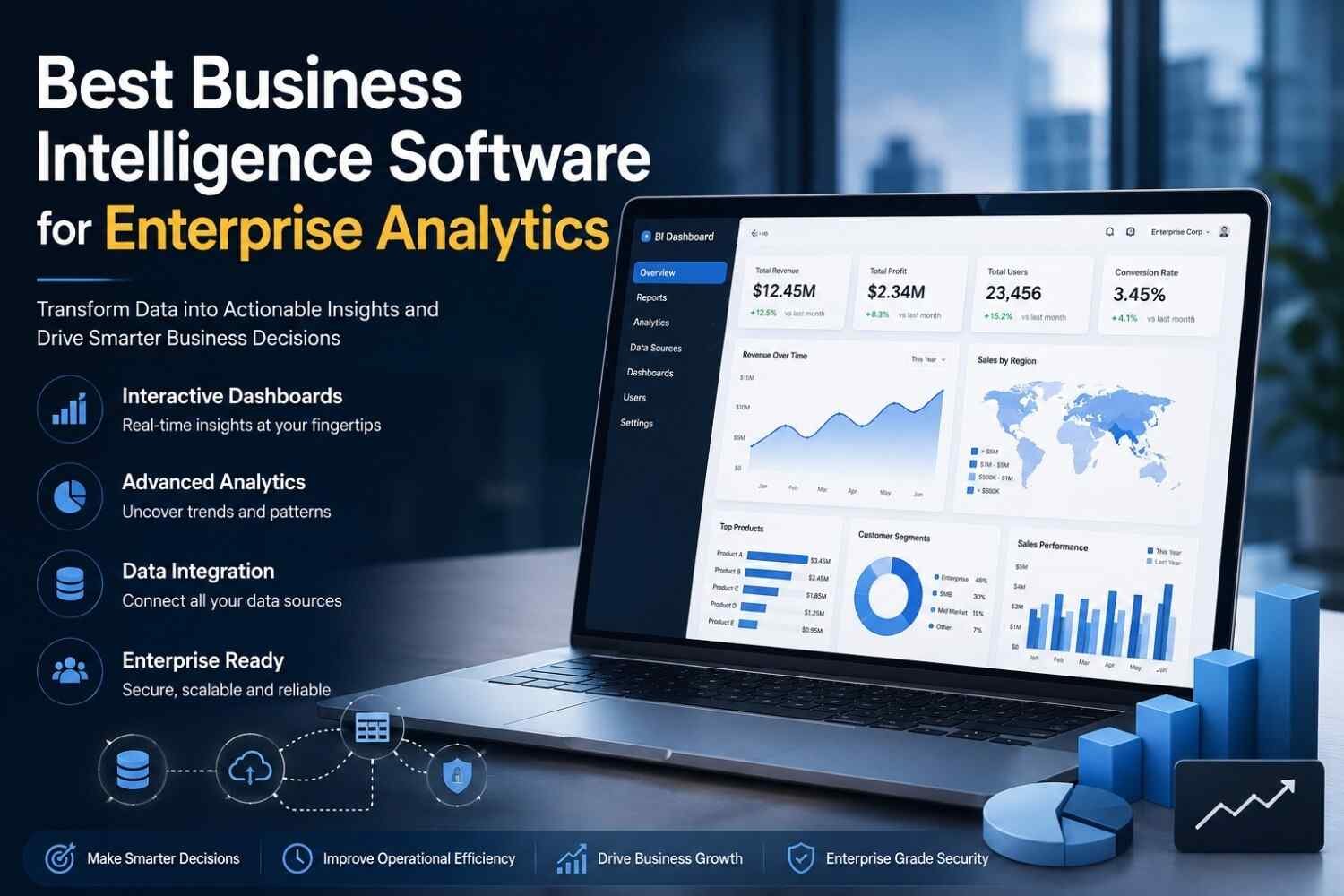
Enterprise organizations generate enormous amounts of data every day. However, raw data alone cannot drive business success. Companies need powerful Business Intelligence Software to transform data into actionable insights, improve operational efficiency, forecast future trends, and make strategic decisions.
Whether you're managing finance, sales, HR, marketing, manufacturing, or customer service, the right Enterprise Analytics Software can provide real-time dashboards, AI-powered reporting, predictive analytics, and advanced data visualization.
What is Business Intelligence Software?
Business Intelligence (BI) Software is a technology platform that collects, processes, analyzes, and visualizes business data from multiple sources. It enables organizations to monitor key performance indicators (KPIs), generate reports, identify trends, and make data-driven decisions.
Modern BI software often includes interactive dashboards, AI-powered insights, predictive analytics, data visualization, real-time reporting, cloud deployment, self-service analytics, mobile access, and automated reporting.
Why Enterprises Need Business Intelligence Software
Large organizations manage millions of records daily across CRM systems, ERP platforms, accounting software, cloud applications, and databases. Without BI software, businesses often face data silos, slow reporting, inaccurate forecasts, poor decision-making, limited visibility, and operational inefficiencies.
Enterprise BI platforms solve these challenges by centralizing data into one intelligent dashboard.
Top Features to Look for in Business Intelligence Software
1. AI-Powered Analytics
Artificial Intelligence automatically discovers patterns, forecasts trends, and provides recommendations. Benefits include sales forecasting, customer behavior prediction, risk detection, and revenue optimization.
2. Interactive Dashboards
Executives can monitor revenue, sales, marketing, inventory, finance, customer satisfaction, and employee productivity in real time.
3. Data Visualization
Modern BI software converts complex data into charts, heat maps, KPI dashboards, interactive reports, and graphs, making business insights easy to understand.
4. Self-Service Analytics
Employees can create reports without depending on IT teams. Benefits include faster reporting, better collaboration, and improved productivity.
5. Cloud Deployment
Cloud Business Intelligence offers lower infrastructure costs, automatic updates, remote accessibility, enterprise-grade security, and high availability.
6. Predictive Analytics
Machine learning models forecast sales, customer churn, inventory demand, market trends, and financial risks.
Benefits of Enterprise Analytics Software
- Faster business decisions
- Improved customer insights
- Better operational efficiency
- Reduced reporting time
- Higher revenue opportunities
- Increased productivity
- Data-driven strategy
- Better forecasting
- Lower operational costs
- Improved ROI
Key Metrics to Monitor
- Revenue Growth
- Gross Margin
- Customer Lifetime Value (CLV)
- Customer Acquisition Cost (CAC)
- Employee Productivity
- Inventory Turnover
- Net Profit
- Sales Conversion Rate
- Marketing ROI
- Operational Efficiency
How to Choose the Right BI Software
Consider scalability, ease of use, AI capabilities, data integration, reporting features, cloud support, security standards, pricing, customer support, and mobile accessibility.
Future Trends in Business Intelligence
- Generative AI for analytics
- Natural language queries
- Augmented analytics
- Embedded BI
- Real-time streaming analytics
- Automated data storytelling
- AI-powered anomaly detection
- Edge analytics
- Collaborative dashboards
- Advanced predictive modeling
Frequently Asked Questions (FAQs)
Which Business Intelligence Software is best for enterprise analytics?
The best solution depends on your organization's size, data sources, budget, security requirements, and analytics needs. Enterprises typically prioritize scalability, AI capabilities, and integration with existing systems.
What are the benefits of cloud-based BI software?
Cloud BI provides lower infrastructure costs, automatic updates, easier collaboration, remote access, and faster deployment.
Can BI software improve business decisions?
Yes. BI platforms transform raw data into actionable insights through dashboards, reports, and predictive analytics, enabling faster and more informed decisions.
Is AI important in modern Business Intelligence?
AI enhances BI by automating data analysis, identifying trends, generating forecasts, and recommending actions, reducing manual effort and improving accuracy.
Conclusion
Selecting the Best Business Intelligence Software for Enterprise Analytics is a strategic investment that enables organizations to convert data into measurable business value. By adopting a platform with AI-powered analytics, real-time dashboards, predictive insights, robust security, and scalable cloud architecture, enterprises can improve operational efficiency, enhance decision-making, and stay competitive in a rapidly evolving market.
As data volumes continue to grow, organizations that invest in modern business intelligence solutions will be better positioned to optimize performance, uncover new opportunities, and achieve long-term success.